In Collaborative Response, the collaborative team meeting (CTM) serves as a critical engine for collective inquiry and shared instructional practice. At the heart of a successful CTM is the pre-meeting organizer, a foundational tool that prepares team members to engage deeply, purposefully, and efficiently.
The primary purpose of the pre-meeting organizer is to prompt personal reflection prior to the meeting so that educators arrive fully prepared. Without this pre-reflection, meetings risk becoming reactive spaces where discussions focus on whatever incident happened most recently on the playground rather than on broader, systemic instructional challenges. Moving through a brief, intentional reflection ahead of time ensures that team members arrive ready to articulate their celebrations and key issues without pausing the collaborative momentum of the room.
At its inception, a pre-meeting organizer should be kept exceptionally simple. The initial version consists of a half-page document often placed right in teacher mailboxes or completed digitally asking for two main components: a student to celebrate along with the reason why, and a student of concern paired with a concise key issue. To maintain focus, teams are encouraged to limit key issue descriptions to eight words or less. This keeps the organizer from turning into a lengthy student referral document or an exhaustive background history, ensuring the focus remains squarely on actionable reflection.
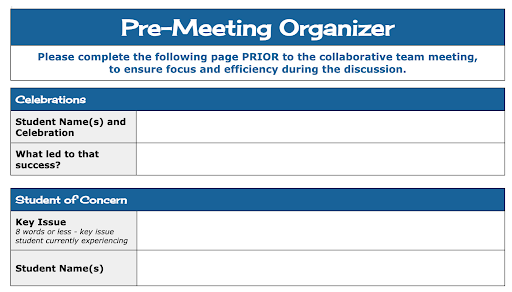
As leadership teams introduce the pre-meeting organizer, various implementation strategies can help reinforce its purpose and support concise completion. Some schools set aside 15 minutes during early dismissal days for staff to complete their organizers in pairs, while others utilize staff meetings to share examples of well-crafted, concise key issues versus overly detailed ones. In other cases, leaders collect organizers a day or two in advance, allowing them to identify common themes across classrooms or connect with individual teachers to refine vague key issues prior to the meeting.
When a section for student strengths and interests is included on an organizer, it is designed strictly as a pre-meeting reflection tool for the teacher, rather than as narrative background to be read aloud during the meeting. Reflecting on a student's strengths beforehand helps the teacher align potential action items to those interests later, while keeping the meeting conversation focused strictly on identifying effective strategies for the key issue.
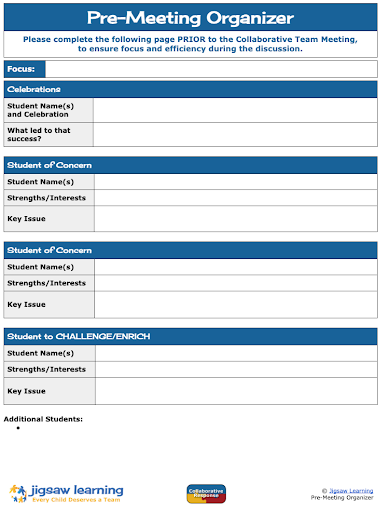
As a school's collaborative culture matures, the pre-meeting organizer must evolve alongside it. Over time, schools transition from subjective reflection to data-informed reflection. By incorporating color-coded data frameworks such as red, yellow, green, and blue, teachers use the organizer to identify "students on the cusp" or "yellow zone" students who are approaching expectations. Aligning the organizer with universal screening or classroom assessment data ensures that teams bring forward the right students who, with a few targeted instructional adjustments, can achieve significant growth.
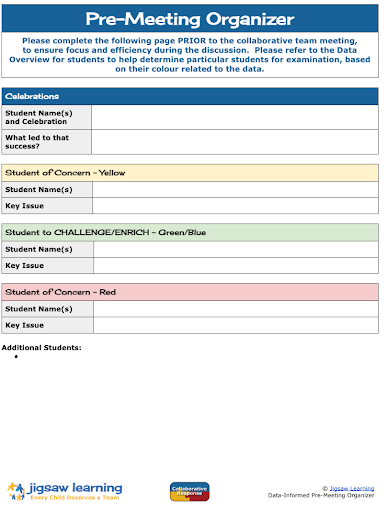
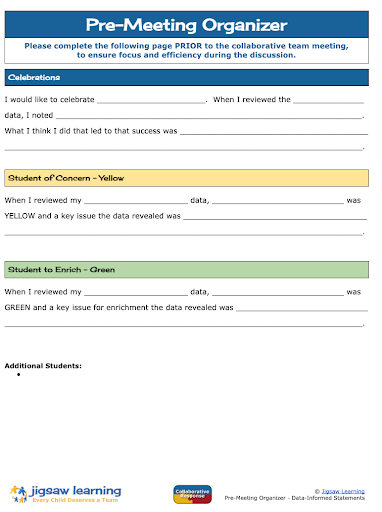
This pre-meeting organizer is a fill-in-the-blank format designed for teachers to complete prior to collaborative team meetings to structure discussions around student data and prepare for the key issue discussion.
Whether managed through simple paper templates or digital platforms like WeCollab where student alerts capture key issues beforehand the pre-meeting organizer plays a pivotal role in streamlining team structures. By shifting the focus from background stories to structured reflection, schools maximize their collaborative time, spending less time diagnosing problems and more time engaging in solutions-oriented thinking.
Please reach out to share your insights, challenges, and triumphs along with your questions, resources, or suggestions related to this topic. Connect with us at or .