When you think about the meetings you hold with your teams, who's usually in charge of leading the conversation? For many organizations, the answer is always the same, the formalized leader (the principal, the manager, the department head).
While it's natural for leaders to take the helm, maintaining a collaborative culture requires shifting that responsibility. Creating opportunities for others to facilitate is a powerful move toward building true distributed leadership and high-impact teams.
First, it’s vital to understand that the role of a facilitator is much deeper than simply "chairing" a meeting.
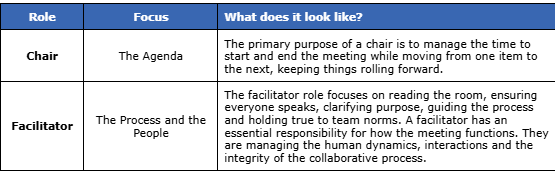
The facilitator is the guardian of the conversation. They ask clarifying questions (e.g., "I think what I'm hearing is this, have I got it?") and, most critically, they ensure every voice is accessed. As the Google Aristotle project discovered, equitable voice is one of the most powerful factors in creating psychological safety which is the bedrock of effective collaboration.
We encourage the principal and/or assistant principal(s) to take on the role of facilitating the collaborative team meetings initially. We recognize the value of modelling for the rest of the team as it is likely that the leadership team has been highly involved in professional learning and navigating the implementation of Collaborative Response and it is logical that they lead the collaborative team meetings to create common understanding of the function and process of facilitating.
We also know, first hand, that the collaborative team meeting is a place where we come to understand the challenges that students are facing and depending on the responses of teachers we may begin to recognize themes across the school that could be translated into professional learning. The focus of the collaborative team meeting is three fold, the needs of students are being met, we are building staff capacity and we’re creating a culture of collaboration where everyone is learning together and depending on each other. When we consider the impact of this process it goes without saying that the leadership teams need to be involved and when first establishing the expectations it is essential that leadership hold the role of facilitator until the structures and processes are understood by the whole team.
Should We Be Distributing the Facilitator Role Over Time?
We recognize that before we begin to distribute the leadership of collaborative team meetings, we should confirm that every team member understands the why, the function and the process of the CTM. When there is a solid understanding across all team members then distributing the role of facilitator can be a strategic move that yields several benefits.
1. Develops Leadership Skills in Others
Facilitating a collaborative team meeting is an advanced skill. It requires deep listening, redirecting colleagues, designing effective key issues and maintaining focus through the processes and structures. By distributing the role, you are providing hands-on opportunities for team members to develop valuable distributed leadership skills that they can carry into all aspects of their work.
2. Deepens Appreciation for the Role
Ask anyone who has been suddenly forced to facilitate: their appreciation for the person who normally does it increases tenfold. When a team member steps into the role for the first time, they gain a renewed understanding of the challenges and focus involved. This leads them to be a better participant in future meetings, more willing to support and guide the process, and less likely to take process redirection personally.
3. Prevents Leader Burnout and Dependency
If the success of every meeting depends entirely on one person, you are creating a culture of dependency. When multiple people can facilitate effectively, the health and effectiveness of your team are not reliant on a single individual.
What Strategies Can Be Used to Support Facilitation?
You can't just throw people into the deep end. Shifting the facilitator role requires a careful, gradual release of responsibility. The following strategies help build the necessary confidence and competence.
1. Model, Coach and Co-Lead the Role
Explicitly model the facilitator role as the leader. Intentionally talk about your actions and continually explain why you are doing what you’re doing. This continual explanation for the whole team will ensure a common understanding of the structures and processes of the collaborative team meeting. It may be useful to engage in a conversation at the end of a meeting, by asking, "What did you notice I did today as the facilitator?"
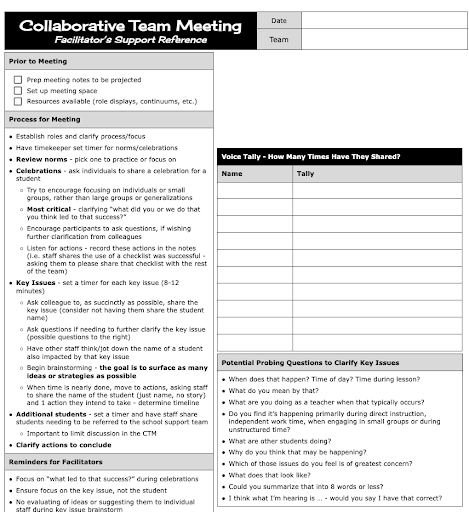
Develop a simple reference sheet or even a tent card displayed on the table that reminds the facilitator of their key moves, such as: "Ask for clarification," "Ensure all voices are heard," or "Redirect to the team norm." We have developed a CTM Facilitator's Support Reference that is intended to be used by the facilitator, however as you begin to prepare others for taking on the role, it would be advantageous to share this resource with the whole team to promote awareness and understanding.
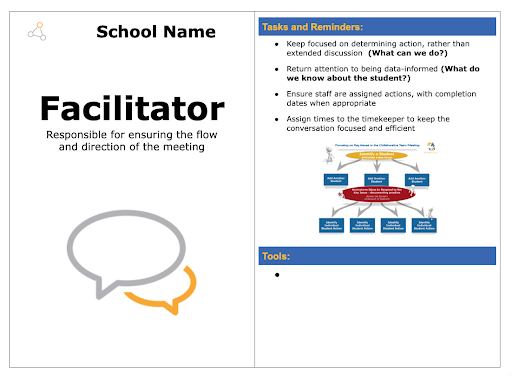
Create table displays that list the current roles (Facilitator, Timekeeper, Notetaker). One side can face the room; the other, facing the role-holder, can share tips or mini-scripts for that specific role. Below is a link to meeting role table displays, with role name and image on front and tasks/tools required on the back.
When you are coaching a team member to take on the responsibility of the facilitator, let them lead but be ready to provide guidance on the side when needed. If the facilitator is nervous, they may forget components of the meeting and it is your responsibility to ask them to go back or to refer to the agenda for the next part of the meeting. Remembering that creating a ‘just right’ key issue can be tricky so it is valuable to be ready to guide the facilitator especially when designing an effective key issue.
2. Normalize Asking Questions with Question Cards
A major barrier to collaboration is the fear of asking a clarifying question, which can sometimes be misinterpreted as questioning a colleague's competence. In order to normalize the concept of questioning for clarity, try using question cards distributed in the team meeting to be used to encourage team members to ask questions throughout the meeting. Below is a template that you can use to print off for your meetings or feel free to add/adjust the questions to best fit your team.
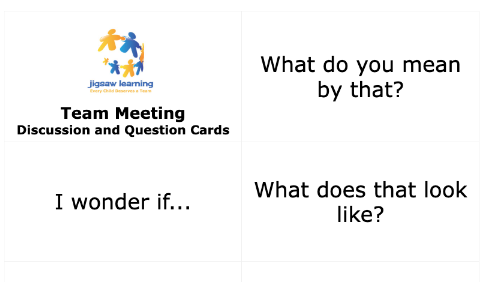
This simple, initially awkward activity normalizes the practice of asking questions, taking the pressure off the facilitator and creating a safer, deeper level of collaboration. Over time, your team will stop needing the cards because the practice will be internalized.
3. Plan the Hand-Off in Advance
Don't wait until the day of the meeting to ask, "Who wants to facilitate?". At the end of a meeting, determine the roles for the next meeting date. This gives a future facilitator time to observe, mentally prepare, and seek guidance from the leader or a colleague if they have any concerns.
Use a simple chart or a fold-out section on your role cards to track who has taken which role and when. This allows you to easily prompt someone who hasn't tried a role: "Justine, I see you haven't taken on the facilitator role yet, would you be willing to give it a shot next month?"
4. Provide Documents for Support
Preparation is an integral component of an effective collaborative team meeting. Meeting with the new facilitator ahead of the meeting to provide answers to any of their questions can support the effective and consistent implementation of the structures and processes. The following template is intended for facilitators to plan for their first collaborative team meeting. This template functions as a lesson plan for the upcoming meeting to provide reflection to ensure the meeting is well prepared.
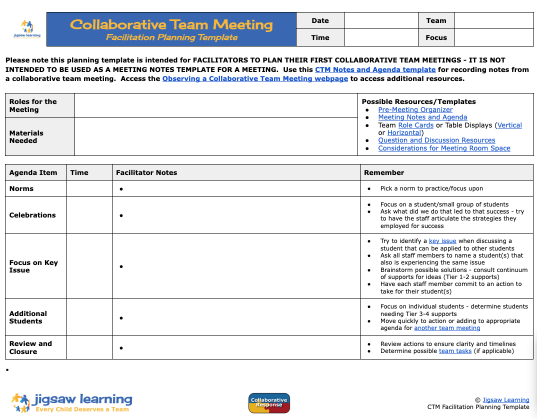
Facilitation is a skill that is learned through practice and supported by explicit modeling. By gradually releasing this responsibility, you will not only build the capacity of your team but also create a more resilient, dynamic, and genuinely collaborative culture.
Please reach out to share your insights, challenges, and triumphs along with your questions, resources or suggestions related to this topic. Connect with us at or .