
When we think about the collaborative team meeting within Collaborative Response, we know it exists to respond to the needs of students. However, it holds a dual purpose: it creates a space to examine our instruction and explore practice as staff in a way that is directly connected to real, in-the-moment student learning. It is about creating sustainable thinking habits across our entire team so that when we face key issues in our classrooms, our collective reaction is to wonder what is possible and determine what we can try.
Examining practice requires intentional time for processing and reflection before, during, and after the meeting. When we first began facilitating these meetings, we will be the first to admit that we did not fully realize the importance of those three distinct stages. Early on, meetings often started with a quick, "Hey, who has a student?" Teachers were forced to think on the fly, jumping straight to a student who had a behavioral or academic challenge just moments prior. That lack of thinking time created a high-pressure environment that failed to elicit the very best of our collective expertise and pedagogical practice.
Life as an educator is incredibly busy, and we rarely give ourselves enough space to pause, reflect, and deeply consider our students' needs. Building processing time into every stage of the collaborative team meeting transforms the experience from a rushed conversation into a deeply meaningful driver of professional growth.
Reflection Before the Meeting
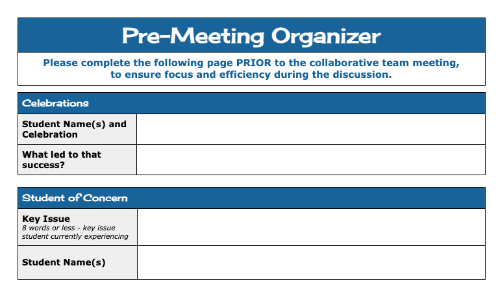
A primary structure that supports processing before stepping into the room is the pre-meeting organizer. Its intent is to give teachers a dedicated opportunity to reflect on their students and articulate what they are seeing in their classrooms prior to the meeting. The following Pre-Meeting Organizer is often used when schools are initiating their collaborative team meetings. This template is a simple half page focusing on one celebration and one student of concern and is printed prior to the meeting and completed on paper in preparation for the CTM.
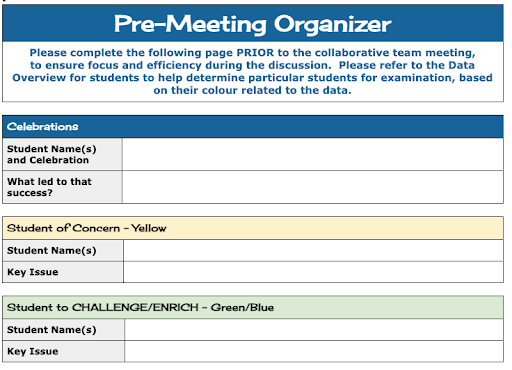
When completing a Data-Informed Pre-Meeting Organizer, teachers turn to their data—often using a simple traffic-light system where red represents students not meeting expectations, yellow represents those approaching, green indicates meeting, and blue signals exceeding—to determine who to bring forward. In a collaborative team meeting, the focus is placed heavily on those "yellow" students who are close to success and need just a few specific supports to thrive with tier-one instruction. Turning to data beforehand provides a straightforward entry point for teachers to identify key issues well in advance. Below is a template of a Data-Informed Pre-Meeting Organizer.
Some schools enhance this pre-meeting reflection even further. If a school is focusing on a specific area like executive functioning, leaders might share a short article, website, or video ahead of time to prime the pump. This quick reflection builds a common understanding, provides shared language for defining key issues, and gets minds engaged before anyone sits down at the table. Other leaders ask teachers to submit their organizers a day or two in advance. This allows facilitators to spot common themes, synthesize topics, and prepare themselves to guide a highly focused conversation.
Processing During the Meeting
Infusing reflection directly into the meeting workflow is one of the most impactful adjustments a facilitator can make. Consider what happens after a teacher shares a refined key issue. Rather than immediately asking the room for verbal suggestions, the facilitator asks every team member to think of a student in their own class who shares that exact same key issue.
Next comes the game-changer, taking just sixty seconds of silent reflection time for everyone to jot down a few quick ideas or strategies on a page or post-it note.
That single minute of quiet processing lowers anxiety for educators who feel hesitant to speak off the cuff or put their ideas on the spot. Written notes provide a sense of security and preparation. For the facilitator, seeing team members write allows for more direct, proactive facilitation. Instead of asking the open prompt, "Does anyone have an idea?"—which usually results in the same two dominant voices stepping in—the facilitator can invite specific individuals to share, directly reinforcing psychological safety through equal turn-taking.
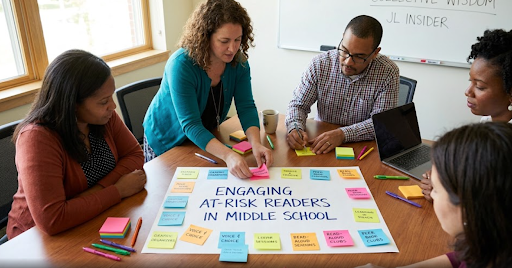
We have also seen teams place an 11x17 sheet of paper in the center of the table with the key issue written in the middle. Following a brief period of silent reflection, team members write one strategy per post-it note and physically place them onto the paper. This tactile activity creates a rich visual representation of collective wisdom that can then be posted in a shared workspace as a continuous reference for the entire school.
Reflection After the Meeting
The reflection process does not end when the team meeting adjourns. Teams need intentional opportunities to reflect on what actions were tried, how those actions went, and what was learned along the way.
Rather than waiting five or six weeks for the next collaborative team meeting, some schools dedicate fifteen minutes of a staff meeting two weeks later to post-meeting reflection. Teachers pull up their notes, look at the action they committed to, and discuss what happened. Did it work? If not, why? What else can we do?
School leaders can also support this reflection during informal classroom walkthroughs. A quick, conversational check-in to ask, "I noticed you were planning to try that graphic organizer strategy with Sue—how did that go for her, and do you need any support?" keeps the focus squarely on student growth and instructional iteration rather than accountability. Our focus is to ensure our actions we have committed to are having an impact for our students.
Some teams even schedule reflection check-ins where everyone intentionally brings an instance where a strategy did not work so the team can unpack the underlying reasons together. Approaching outcomes through this lens reinforces the core ethos of Collaborative Response, every team member enters the room as both a learner and an expert, continuously building habits of reflection that elevate practice across the entire school.
Please reach out to share your insights, challenges, and triumphs along with your questions, resources or suggestions related to this topic. Connect with us at or .


