
Moving Beyond "Adults in a Meeting"
When people first experience or watch a collaborative team meeting in action, the feedback we hear most often is about the sheer amount of structure. It looks mechanical, formalized, and completely different from a normal meeting. It’s easy to think, "Do we really need all of this stuff? After all, we are adults. We know how to work in a meeting, and our school collaborates well already."
While that may be true, introducing formalized structures takes collaboration to a completely different level. Roles can feel strange or mechanical when you first start, but they have a dramatic, positive impact on your team interactions. This is one of the structures that when used regularly and with fidelity, it leads to building psychological safety within the team which results in highly collaborative cultures.
Why Roles are Critical to Success
As a leader, it's easy to fall into the trap of trying to do everything yourself. You might think you're doing the team a favor by taking on the heavy lifting, facilitating, note-taking, and keeping an eye on the time so everyone else can just focus on the conversation.
But when a leader tries to own all those roles, two things happen: you don't do as good a job at any of those individual tasks, and you miss a massive opportunity to build capacity.
Because a CTM has a highly defined structure, relying on one person to manage the clock, capture the notes, and guide the human dynamics is foolhardy. It is incredibly difficult to listen deeply to a conversation when you are struggling to type it out. Roles distribute the leadership and ensure everyone is responsible for the movement and success of the meeting.
Rotating these roles from meeting to meeting also builds incredible empathy and grace across the team. When you've experienced how hard it is to capture a rapid-fire brainstorming session as the note-taker, you're much more likely to step in and support the person in that role next time. Most importantly, shared roles build sustainable, distributed leadership. If the principal or main facilitator is absent, the meeting doesn't stall (or worse get canceled) because the capacity and ownership are shared across the whole table.
The Big Three: Where to Start
We sometimes hear about schools seeing a video of a team utilizing eight different roles, so they try to introduce eight roles right away. Please remember, they didn't start that way! When you are first establishing your CTMs, start with the core three:
- The Facilitator: This role is critical for guiding the process and the people. Unlike a traditional meeting chair who simply moves from item to item, a skilled facilitator reads the room, ensures everyone has an equal voice, listens and manages the human dynamics.
- The Recorder / Note-Taker: To maximize the effectiveness of this role, we highly recommend projecting the notes. Having a visual anchor point minimizes distractions and helps the team remember the full list of brainstormed ideas. Try introducing a "second note-taker" sitting next to the primary recorder to seamlessly slide the laptop over when someone wants to speak and have their thoughts captured.
- The Timekeeper: This person keeps the team moving efficiently through the defined agenda by setting timers and giving clear visual cues to the facilitator as time winds down.
Adding Roles Responsively
You should only introduce additional roles as a direct response to a specific need or challenge you are seeing in your meetings. Here are a few responsive roles we've seen schools implement beautifully:
- The Interrupter: If you find your team constantly getting stuck in "storytelling mode" or going off on tangents about a student's history, the Interrupter is explicitly tasked with gently bringing the group back to the pathway.
- The AI Activist: If a small team has taught together for years or conversely are a team of brand new teachers and find themselves hitting a wall during the brainstorming phase, the "AI Activist" member uses a device to look online or run a prompt to pull in 20 fresh classroom strategies for the team to consider.
- The Norm Analyst (or "Norm"): This person keeps the team accountable to their agreed-upon behaviors. One school we visited even gave "Norm" a Staples "Easy Button" to press whenever the conversation drifted outside of the team's locus of control!
- The Passionate Participant(s): This role is assigned to everyone else in the meeting that does not have a specific role. This allows the team to clearly articulate the expectations for participants in the meeting, clearly describing on this role card the expectation that participants listen intently and share ideas readily.
Determining roles during a team meeting can ensure greater efficiency in conversations, attendance to processes and established structures, and distributed leadership across the team. This resource shares a number of roles that could be considered for team meetings.
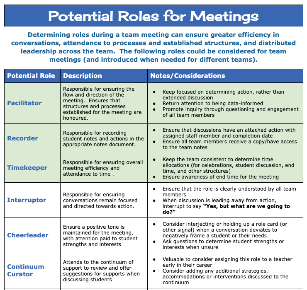
In addition, here is a folder of several samples shared by schools who are engaging in this work.
Onboarding and The Role of the Observer
An idea that we have seen have a massive impact when onboarding new staff or scaling your collaborative structures is assigning a role of the observer. A principal recently shared that they brought a staff member into a pilot meeting who hadn't been part of the initial pre-work or norm-setting. Wanting to talk about a specific student, the guest unintentionally derailed the defined key issue process. The school asked themselves, "What if guests or new staff joined the meeting with the defined role of The Observer?"
By giving someone a clear card that defines their job as strictly listening and watching, they get to learn the mechanics of the structure without accidentally shifting the meeting's focus. Schools that have used the Observer role find that their subsequent teams actually look better and launch faster than their first pilot teams because the staff had the chance to witness the model successfully first.
Roles are incredibly important for ensuring your collaborative team meetings run effectively, and honestly, any school meeting would benefit from employing them.
What roles are you currently utilizing in your team meetings, and how have they shifted your collaborative culture? Email us at or connect directly at to share your insights and triumphs!


